I have written about this in pieces. Visa overstay is not a technicality. The law is not a suggestion. Citizenship is not a costume you put on when the benefits are good and take off when the duties are inconvenient. In Mapped. No soft edges. I said the defense of this country is supposed to happen the right way — through the ballot box and the rule of law.
That sentence only holds if the ballot box is real.
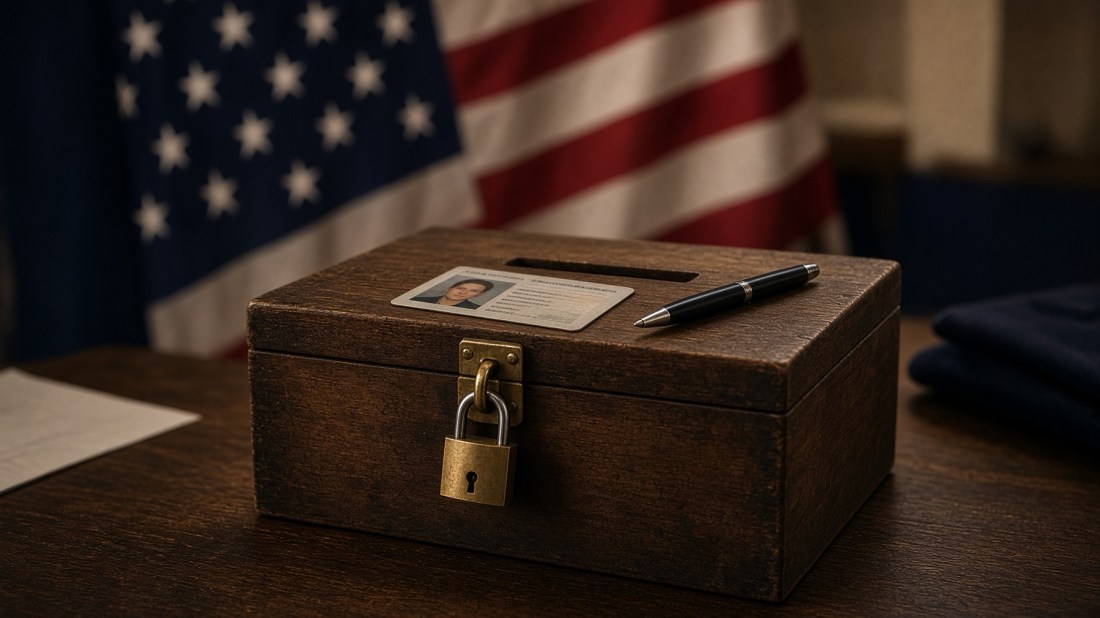
So here is the more current, more exhaustive look — not at personalities, not at who you like this November, but at whether the machinery we are about to use again deserves the word election. Midterms are weeks away. The rules on the books in too many states still look like this: mail-in ballots with no photo ID, same-day registration, vouching, stretched early voting, and counting that continues after the public Election Day is over.
That package has a name. It is a low-verification, high-volume voting regime.
What those rules actually do
Strip the slogans and look at the mechanics.
Mail-in ballots with no real ID. The voter is not in the room. Identity is often a signature match — subjective, county by county — or a number that is not checked the way a photo ID is checked at a poll. The ballot travels through a mailbox, a drop box, a kitchen table, sometimes a third party. Once the envelope is separated and the paper goes into the stack, you cannot reconstruct who marked it. That is not a conspiracy theory. That is the architecture. Even federal cybersecurity guidance has noted the obvious: mail voting raises the risk of integrity attacks on registration systems because the voter is not present to resolve problems in real time.
No ID at the polls. Every other high-stakes transaction in American life asks you to prove you are you. Flying. Driving. Banking. Buying alcohol. Picking up a package. Casting the vote that decides who writes the laws is treated as the one act too sacred for a driver’s license. That is not compassion. That is a lowered standard.
Same-day registration. Officials get hours, not weeks, to confirm you live where you say you live and that you are eligible. A utility bill is not a citizenship check. Volume is the point. Verification is the casualty.
Vouching. Another person attests that you are who you claim to be. That is a social courtesy, not a control. A republic does not run on “my friend says so.”
Long early voting plus late counting. Convenience is real. So is a longer chain of custody, more temporary staff, more days for ballots to sit and get “cured,” and results that drip out after the country thinks the election ended. Partisan splits in how people vote — in person versus mail — produce the same movie every cycle: one side looks ahead on Tuesday night, the other side catches up when the envelopes get opened. The Supreme Court in Watson v. RNC this June allowed states to keep counting mail ballots received after Election Day if they were postmarked on time. Legal in those states. Also why a large share of the public no longer treats Election Night as the election.
None of that requires a theory of millions of fake ballots in every race. It requires only this: close elections are decided at the margin, and a system that does not verify identity up front is a system that cannot later prove the result was clean.
The sentence they want you to swallow
Here is the move. Officials and activists say, “We found almost no fraud.” Then they treat that sentence as the end of the argument.
It is not.
Absence of proof is not proof of absence when the system was never built to generate the proof.
A poll-site photo ID, a poll book signed in front of two workers, and a ballot that never leaves a supervised room produce a record you can audit. A mailed ballot separated from its envelope, a same-day registrant checked against a bill, a voucher, and a count that continues after the deadline produce a thinner record on purpose. Prosecutors need a high burden. Ballot secrecy is protected. County officials have every incentive to certify and move on.
So when they say they found almost no fraud, they are reporting on what their process is capable of seeing.
In-person impersonation is hard and leaves a witness trail. It shows up rarely because it is rare and because it is the one method with eyes on it. Mail, drop boxes, harvesting, coercion at the kitchen table, ballots sent to stale addresses, registration mills, and double voting across jurisdictions leave less contemporaneous evidence. Those are also the methods that dominate the cases that do get proven. The Heritage Foundation’s database is a sampling of convictions and official findings — not a census of everything that happened. Treat it that way. What it still shows is not “zero.” It shows that when fraud is caught, it is caught most often where the voter was not standing in front of a worker with an ID in hand. A congressional race in North Carolina was thrown out over absentee abuse. That is not folklore.
Two things can be true at once:
- The number of convictions is small relative to hundreds of millions of ballots. Anyone claiming industrial-scale, easily visible fraud in every cycle is overselling.
- A low conviction count is exactly what you should expect if the front-end controls are weak.
You do not wait to find a body in every alley before you put locks on the doors. You do not congratulate the store for “no shoplifting” after you took the cameras down.
Who sells the “insurmountable burden” story
The coalition that treats photo ID, limits on no-excuse mail, an end to same-day registration, and a hard receipt deadline as “voter suppression” is not mysterious. Democratic Party organs. The Brennan Center. The League of Women Voters. The Fair Fight network. The usual civic dark-money web that recodes ordinary verification as Jim Crow 2.0.
The pitch is always the same: Black, Latino, Native, elderly, poor, and disabled voters cannot reasonably obtain ID, travel, or meet a deadline. Therefore loosening every control is a civil-rights necessity.
That argument has two problems, and both are fatal.
First, the people they claim to speak for mostly reject it. In Pew’s August 2025 survey, 83 percent of U.S. adults favored requiring government photo ID to vote — White 85 percent, Hispanic 82 percent, Asian 77 percent, Black 76 percent. Even 71 percent of Democrats favored it. Other polls show the same pattern among lower-income voters. If a rule is “racist in effect,” explain why the people supposedly crushed by it keep telling pollsters they want it.
Second, the “cannot get ID” line is paternalism dressed up as justice. Adults in those groups already use ID to fly, drive, work, bank, and buy regulated goods. States with ID laws issue free voter IDs. After Georgia tightened absentee ID and drop-box rules in 2021, minority turnout did not collapse. Subsequent cycles were high. If a requirement is insurmountable, turnout should crater. It does not.
I did not come to this country to be told that people who look like me are too helpless to produce the same document they use at the airport. That is not solidarity. That is contempt with a press release.
Why this is an immigrant’s issue
I took an oath. I learned the language. I waited. I followed the process. Millions of us did. The cheapening of the ballot is the cheapening of that oath.
If anyone can be registered at the last hour with a piece of mail, if anyone can vote without proving who they are, if ballots can be harvested and counted after the country thinks the race is over, then citizenship is a formality and allegiance is a speech. The three pillars I write about — Accountability, Assimilation, Allegiance — do not stop at the border. They apply to how we choose the people who write the laws.
A country that will not enforce who may enter will not stay serious about who may vote. A country that will not confirm who voted will not stay serious about who governs. Those are not separate fights. They are the same refusal to draw a bright line.
I live in Minnesota. We have same-day registration and we do not require photo ID at the polls. Signature. Affidavit. In some cases, a voucher. I am supposed to call that “access.” I call it a decision to trust volume more than verification. You can like high turnout. You cannot pretend high turnout plus weak identity checks equals high confidence.
What would make the upcoming elections credible
Not a personality. A process.
- Photo ID to vote in person, with a free ID for anyone who does not have one.
- The same identity standard for a mail ballot — a copy of ID or a unique ID number that is actually checked — and mail reserved for people who cannot get to a poll, not as the default for everyone.
- Registration closed with enough time to verify residency and citizenship against real databases. Same-day registration is a slogan that treats eligibility as an afterthought.
- No vouching. Another voter is not a passport.
- Ballots received after Election Day do not count. Election Day means something or it means nothing.
- Clean rolls. Dead people, movers, and non-citizens do not stay “active” because updating a list is called suppression.
- Chain of custody that can be explained to a skeptical adult without a lecture about “trust the officials.”
Some of that is moving at the federal level this year — citizenship verification orders, Postal Service standards for election mail, bills that would put photo ID on federal elections. States still run the show. States still choose whether Tuesday night is the election or just the beginning of the argument.
I am not asking you to believe every rumor on the internet. I am asking you to stop accepting a rigged standard of proof. “Show me widespread fraud” is easy to demand from a process designed not to capture it. The honest demand is the reverse: show me the verification that would have made fraud hard to commit in the first place.
If we want to know the result is clean, we verify identity and eligibility before the ballot becomes anonymous paper. We do not pat ourselves on the back afterward for not finding what we made difficult to find.
The republic does not run on autopilot. Neither does an election.
LIVE GRATEFUL 🇺🇸
(It starts in The Spine NOT on your Knees.)
– A Grateful Immigrant


 Grateful Immigrant